Germany has a long history of academic excellence, nurturing some of history’s greatest minds, including Albert Einstein, Alexander von Humboldt, and Max Planck. Today, Berlin is one of Europe’s and the world’s largest scientific hubs, where over 200,000 individuals work, teach, study, and conduct research.
If you are planning to pursue a PhD in Germany, you will find flexible program structures, various funding opportunities and mostly programs taught in English. Germany comes at #3 in the world with highest GDPs in research and development. A doctorate from Germany holds significant value in both academia and industry helping you land competitive, well-paying positions globally.
Phd Program Structure:
You can fund your PhD in Germany through these two paths:
Phd through individual research:
- In Individual research PhD, you’ll have to work independently under a professor’s supervision, which is ideal for self-motivated researchers who prefer flexibility in their research timeline.
Phd through a structured program:
- Structured PhD programs, similar to the US model, are ideal for candidates who want a clear path for their degree. It provides a more organized approach with regular coursework and progress monitoring. It takes 3 to 5 years to complete a structured program Phd.
You can obtain a free PhD in Germany through both methods, as various funding opportunities are available for doctoral programs.
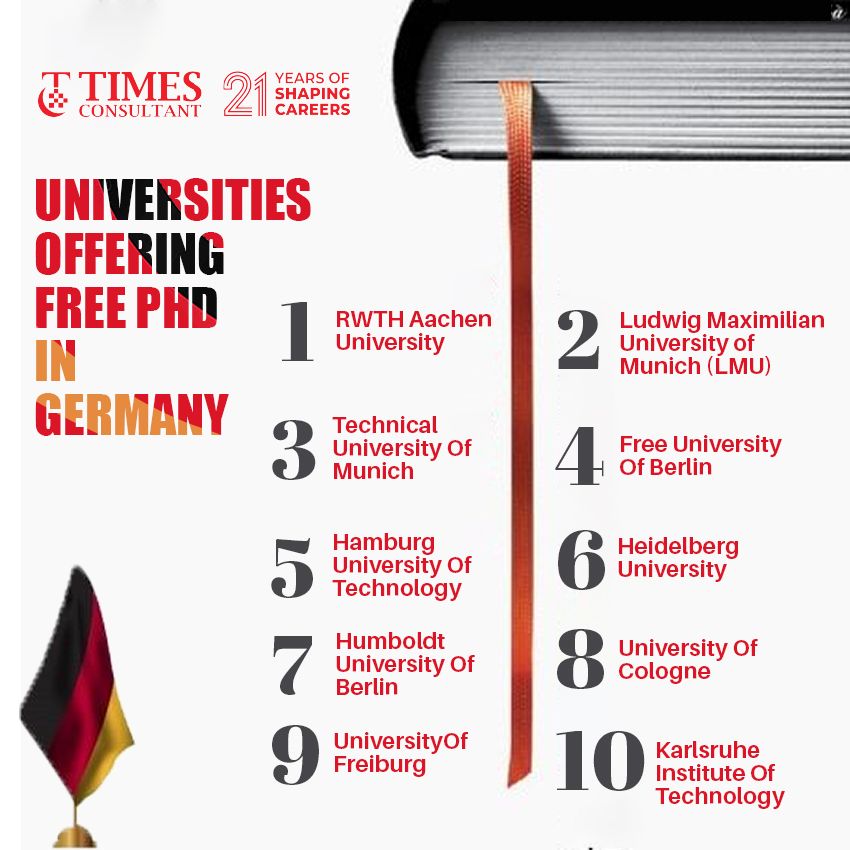
Universities offering free PhD in Germany
The following universities offer tuition-free PhD programs in Germany:
- RWTH Aachen University
- Ludwig Maximilian University of Munich (LMU)
- Technical University of Munich
- Free University of Berlin
- Hamburg University of Technology
- Heidelberg University
- Humboldt University of Berlin
- University of Cologne
- University of Freiburg
- Karlsruhe Institute of Technology
Doctoral programs funding:
Funding options in Germany are diverse and substantial. The most common one is through research assistant positions, offering monthly salaries between €2,000 and €2,800. Added benefit to this is health insurance and social benefits. Other full funding sources are scholarships from DAAD, university-specific grants, and industry-sponsored programs through collaborations with research institutes and companies.
Admission requirements:
The admission requirements are different based on institution and research areas you are applying to. But generally, you’ll need the following documents to apply for a doctoral program in Germany.
Candidates need a strong master’s degree (German grade 2.0 or better), research proposal for individual PhDs, and demonstrated language proficiency. English-taught programs usually require IELTS (6.5+) or TOEFL (90+) scores, while some programs may require German language skills at B2/C1 level.
Career prospects:
Post-graduation opportunities in Germany are particularly attractive. The country offers an 18-month job-seeker visa for graduates, providing ample time to secure positions in academia or industry. Germany has a strong research and development sector in engineering and technology. This offers competitive salaries and chances to advance in your career. Many international graduates get permanent jobs in German universities, research institutes, and companies.
For a full breakdown of tuition policies, universities, and costs, see our Free Education in Germany guide.
Final Thoughts
Getting a PhD in Germany is a smart choice that can benefit you academically and professionally. Germany offers excellent research opportunities, low tuition fees, and significant funding support for students. This creates a great setting for your doctoral studies.
Need help shortlisting supervisors, refining your proposal, mapping deadlines, and preparing funding/visa documents? Contact Times Consultant**, Pakistan’s largest study-abroad consultant with 20+ years of experience.**