TU9, short for “Technische Universität 9,” is an alliance of nine leading technical universities in Germany, formed back in 2003 during the Bologna reforms. This alliance represents Germany’s oldest and best technical universities, which have turned ‘Made in Germany’ from a simple label into a global standard of quality. The collaboration group was established to pioneer and excel in interdisciplinary research in engineering and technology, serving as a bridge between society, educational institutions, and the tech industry.
A defining feature of the TU9 group of Germany is its global perspective. They cultivate a dynamic and inclusive work environment, have partnerships with top institutions worldwide, and uphold the international reputation of German Engineering.
Why Study at a TU9 University?
Choosing a TU9 university lets you experience an environment of discovery and impact. You will have access to globally acclaimed experts, interdisciplinary research opportunities, collaborations with local and international companies, and plenty of room for creativity. The university culture at TU9 is open, inclusive, and globally minded. TU9 Universities are focused on sustainable development, making an impact locally and worldwide. TU9 Universities Ranking is the primary criterion that makes these universities stand out for engineering degrees in Germany.
Here’s what sets these institutions apart:
Research Excellence:
- 21% of German Research Foundation (DFG) funding across all disciplines and 49% in engineering is secured by TU9 universities, which are used for research and innovation. RWTH Aachen’s work in wind tunnels, TU Dresden’s biomedical research, and the Technical University of Braunschweig’s work in meteorology are examples of their research capabilities.
Industry Ties:
- Global automotive and other companies working in sustainability, like Siemens, BMW, and BASF, as well as dynamic startups, have ties with the Tu9 group of Germany. These partnerships contribute to the high employability rate of Tu9 University graduates.
Affordability:
- TU9 institutes are in the public sector, so they don’t charge any tuition fees from domestic or international students. You just have to pay a semester contribution fee of €200-€350. This makes TU9 education both prestigious and accessible. For a broader view of tuition policies across the country, see our Free Education in Germany guide.
Global Recognition:
- Five TU9 universities rank among the world’s top 200, and all are highly regarded by employers worldwide. Students graduate with training and practical expertise. These top TU9 rankings are a big reason to choose these universities.
English-Taught Programs:
- With over 200 English-taught programs, TU9 universities cater to both domestic and international students. Engineering and IT courses, including aerospace engineering, data science, and computer science, are widely available in English. You can also check our Best IT Universities in Germany offering Free Education guide for more details on top-ranked IT institutions.
Diversity:
- With over 280,000 students, including more than 60,000 international students, TU9 campuses are vibrant and inclusive, bringing together global perspectives and collaboration.
TU9 Universities Germany List
Let’s get into the unique strengths of each TU9 university, their academic offerings, and campus environments. The following is the official TU9 universities list:
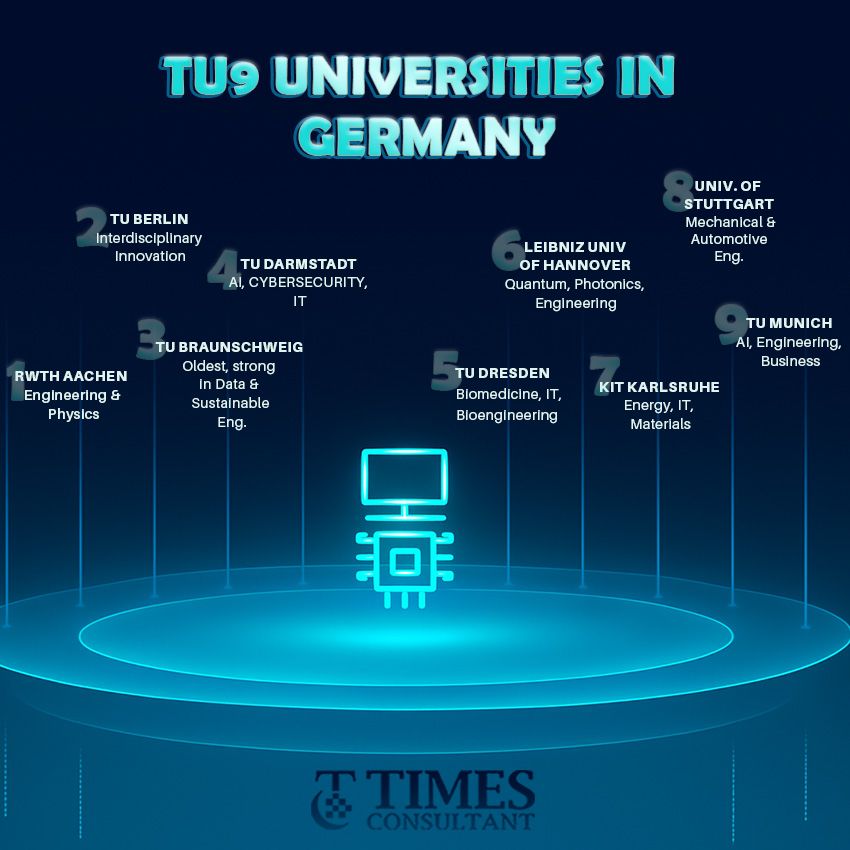
1. RWTH Aachen University
Situated in Aachen, near the borders of the Netherlands and Belgium, RWTH Aachen is a known name in engineering education. It is ranked at no.5 by QS National ranking in Germany. The most popular programs offered by RWTH are physics, natural sciences, engineering, and business. Its historical contributions, such as the world’s first particle accelerator, underscore its research excellence.
2. Technical University of Berlin
Located in the capital, Berlin, TU Berlin is known for its technical expertise with interdisciplinary innovation. Its 33,500 students across seven faculties engage in research, from environmental solutions to urban technology.
3. Technical University of Braunschweig
Based in northern Germany, TU Braunschweig is the oldest technical university in Germany, founded in 1745. Its engineering program is ranked at #25 by QS subject rankings. The top 3 programs offered here are Computational Sciences in Engineering (CSE), Data Science, and Sustainable Engineering of Products and Processes.
4. Technical University of Darmstadt
In Darmstadt, the most popular programs offered by TUD are computer science and modern engineering. The university has done some great work in AI, cybersecurity, and Information technology. According to THE subject ranking, computer sciences falls under the top 100 and engineering under the top 150.
5. Technical University of Dresden
As Saxony’s largest university and a “University of Excellence,” TU Dresden offers 124 disciplines across its 18 faculties. Its programs in biomedicine, bioengineering, and IT are the most popular among international students.
6. Leibniz University Hannover
Leibniz University is also one of Germany’s oldest technical universities, offering 190 programs across nine faculties. It is known for its practical engineering and science programs. The university has recently secured three clusters of excellence and funding for work in photonics, quantum frontier, and personalized care for hearing loss.
7. Karlsruhe Institute of Technology (KIT)
KIT, located in Karlsruhe, functions as a university and research center. KIT is unique among the Tu9 list as it merged with a national research center, creating Germany’s first university excellence cluster. Its popular programs are energy, IT, and materials science.
8. Technical University of Munich (TUM)
TUM, based in Bavaria, is a globally known name in engineering, AI, and business. With 62 English-taught programs and a network of Nobel Prize-winning alumni, it thrives in Munich’s environment.
9. University of Stuttgart
Founded in 1829, Stuttgart is renowned for mechanical and automotive engineering. Its strong industry ties with Germany’s automotive sector and extensive exchange programs make it a top choice for engineering students.
What Do You Need to Get In?
Admission to TU9 universities is competitive, but equally accessible for international students. 25% of the total international students studying in Germany are studying in the TU9 universities. Most of their programs are taught in English and are tuition-free for international students. To get into these universities, focus on the following tu9 universities requirements to make up a strong case.
- Academic Excellence: A strong GPA, particularly in STEM subjects, is essential. International students need a high school diploma equivalent to the German Abitur, and some may require a Studienkolleg preparatory course.
- Language Proficiency: While many programs are in English (requiring TOEFL or IELTS scores), some demand German proficiency (DSH or TestDaF).
- Application Requirements: Prepare transcripts, a CV, a motivation letter, and, in some cases, recommendation letters. Each university has unique application processes, so check their websites.
- Extracurriculars: STEM-related activities, internships, and volunteer experience can strengthen your application.
Are TU9 Universities Worth the Hype?
The TU9 alliance’s reputation is well-earned, with unmatched research opportunities, industry connections, and global recognition. While other German universities, such as Saarland or LMU, excel in specific fields, TU9 schools are particularly strong in engineering and technology. The choice depends on your academic and career goals, but for STEM-focused students, TU9 universities offer a direct path to impactful careers. The TU9 world ranking highlights the strong academic reputation and research excellence of Germany’s top technical universities.
Final Thoughts
With no tuition fees, diverse programs, and a commitment to shaping the future, these institutions are an excellent choice for aspiring engineers, scientists, and technologists. Joining a TU9 community is all about real-world impact. Places like TU Munich and RWTH Aachen have been training engineers for over 100 years. They pull in massive research funding, like 21% of Germany’s DFG grants. No tuition fees for most students and 60,000 international peers make it welcoming and affordable.
Get in touch with Times Consultant today to get into one of the world’s best engineering universities in Germany. We will help you navigate the journey to get tuition-free, quality education at tu9 universities.